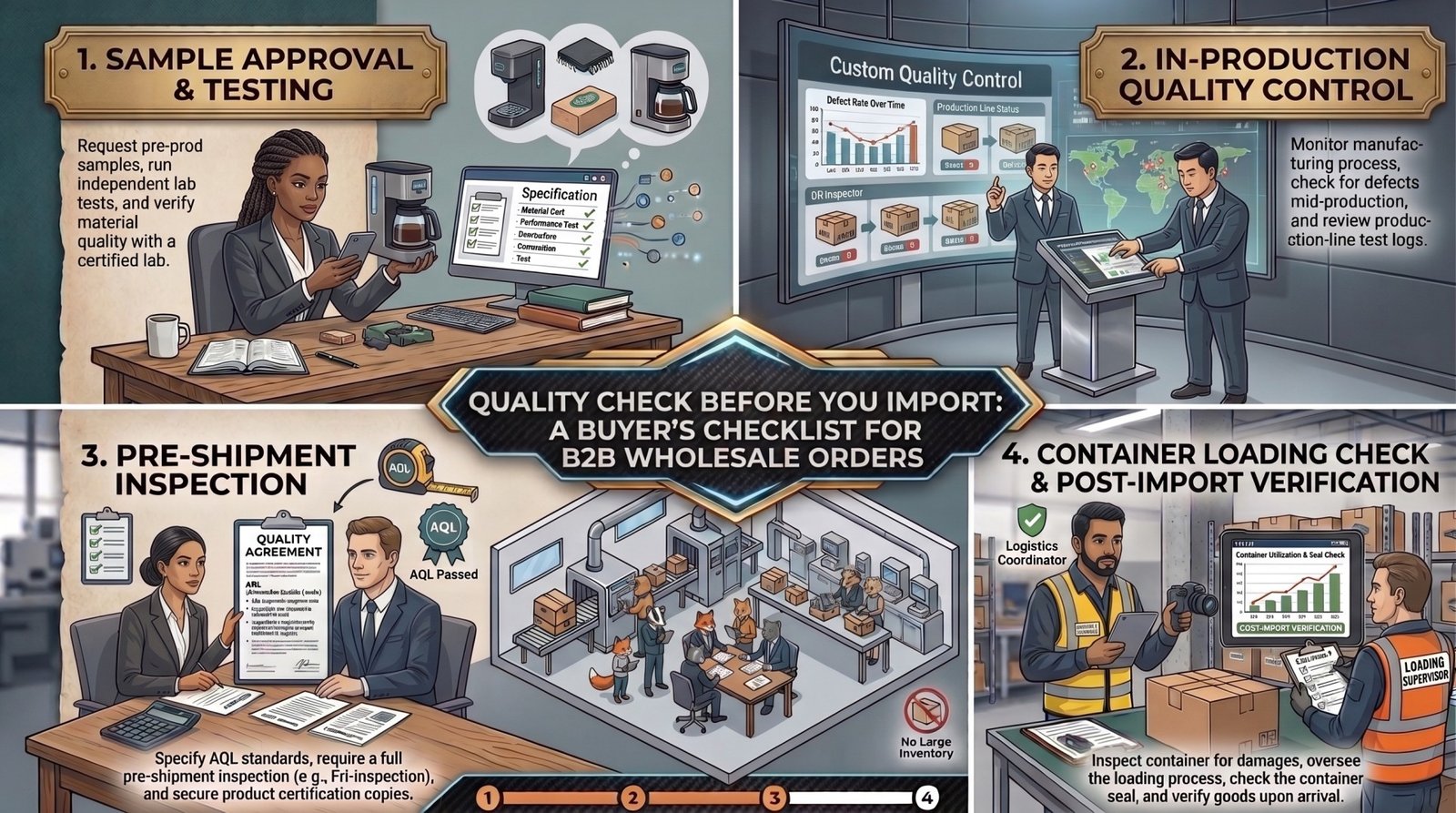
Quality Check Before You Import: A Buyer's Checklist for B2B Wholesale Orders
Importing products in bulk can help businesses access competitive wholesale pricing and expand their product range. But a large order also means that a small quality problem can become a significant financial loss.
A damaged, defective, incorrectly sized, poorly packaged, or completely different product can create problems with customers, returns, storage, and cash flow.
That is why a proper quality check before import should be part of every B2B wholesale purchasing process.
From requesting samples to inspecting products before shipment, buyers can take several practical steps to reduce the risk of receiving products that do not match the agreed specifications.
Why Quality Checks Matter in Bulk Imports
When purchasing a small quantity locally, it is often possible to inspect the product before completing the transaction.
Bulk international sourcing works differently. You may be purchasing hundreds or thousands of units from a supplier located in another city or country.
Once the shipment has been dispatched, resolving quality issues can become more complicated and expensive.
A proper quality-check process can help identify issues such as:
-
Incorrect product specifications
-
Different materials or components
-
Manufacturing defects
-
Incorrect dimensions
-
Poor finishing
-
Damaged packaging
-
Missing components
-
Incorrect colours or designs
-
Wrong quantities
-
Product variations between samples and bulk production
Quality checks are particularly important when products are being sold under your own brand or supplied to your business customers.
The objective is not simply to find defective products. It is to confirm that the finished order matches the specifications, sample, quantity, packaging, and quality standards agreed with the supplier.
Pre-Order: Requesting and Verifying Samples
The quality-check process should begin before placing the bulk order.
A product sample gives you an opportunity to evaluate the supplier's actual product rather than relying entirely on photographs, descriptions, or catalogue information.
Ask for a Physical Sample
Whenever practical, request a sample before confirming a large order.
Inspect the sample for:
-
Material quality
-
Dimensions
-
Weight
-
Colour
-
Finish
-
Functionality
-
Construction
-
Packaging
-
Labelling
-
Accessories or components
For technical or manufactured products, also check whether the product performs according to the required specifications.
Document the Approved Sample
Once you approve a sample, keep proper records.
Take photographs and document important specifications such as:
-
Product dimensions
-
Material
-
Colour
-
Weight
-
Packaging
-
Logo or branding
-
Product model
-
Components included
-
Functional requirements
This creates a reference point that can be compared against the final bulk production.
Clarify Product Specifications in Writing
Do not rely only on verbal conversations.
Make sure important requirements are included in the quotation, purchase order, invoice, product specification sheet, or other written documentation.
The more clearly the product is defined, the easier it becomes to identify whether the final shipment matches what was agreed.
Pre-Shipment Inspection Checklist
A pre-shipment inspection takes place after production is completed or sufficiently advanced but before the goods are shipped.
Depending on the product and order size, the inspection may be performed by the buyer, supplier, or an independent inspection company.
Here is a practical checklist to follow.
1. Product Appearance
Check whether the finished products match the approved sample.
Look for:
-
Scratches
-
Cracks
-
Stains
-
Uneven finishing
-
Manufacturing marks
-
Colour differences
-
Deformation
-
Surface defects
2. Dimensions and Specifications
Measure products where dimensions are important.
Verify:
-
Length
-
Width
-
Height
-
Weight
-
Thickness
-
Capacity
-
Size variations
-
Technical specifications
Do not assume that a product remains identical to the sample throughout mass production.
3. Functionality
If the product has moving parts, electrical components, mechanical functions, or other performance requirements, test them before shipment.
Depending on the product, this may include:
-
Power testing
-
Operation testing
-
Load testing
-
Connectivity testing
-
Battery testing
-
Assembly testing
-
Safety-related checks
The exact tests should depend on the product category and applicable requirements.
4. Quantity Verification
Confirm that the supplier has produced the agreed quantity.
Count cartons and, where appropriate, verify the number of units inside selected cartons.
A shipment containing the correct products but an incorrect quantity can still create financial and operational problems.
5. Packaging Inspection
Packaging should also be checked before dispatch.
Verify:
-
Carton condition
-
Internal protection
-
Product labels
-
Barcodes
-
Shipping marks
-
Individual packaging
-
Required documentation
-
Quantity per carton
Good packaging can reduce the risk of damage during transportation.
6. Branding and Labelling
For private-label or branded products, verify every branding element.
Check:
-
Logo placement
-
Logo size
-
Printed text
-
Product labels
-
Model numbers
-
Barcodes
-
Packaging design
-
Language requirements
A small printing or labelling mistake can affect an entire production batch.
7. Compare Against the Approved Sample
Finally, compare the production batch directly with the approved sample.
Do not evaluate the bulk order in isolation.
The question should be:
"Does the finished product match what we approved and ordered?"
This comparison can reveal differences that may otherwise be overlooked.
Red Flags That Signal Poor Supplier Quality
Certain supplier behaviours should encourage buyers to conduct additional checks before proceeding.
Supplier Refuses to Provide Samples
If a supplier consistently refuses reasonable sample requests, investigate the reason before placing a large order.
Specifications Keep Changing
Frequent changes to product materials, dimensions, components, or packaging should be documented and approved before production continues.
Supplier Avoids Written Confirmation
Important specifications should not exist only in informal conversations. Ask the supplier to confirm commercial and product details in writing.
Bulk Product Looks Different From the Sample
A significant difference between the approved sample and mass-produced goods is a clear reason to pause shipment and investigate.
Extremely Low Pricing
An unusually low quotation may sometimes come with compromises in materials, components, finishing, or quality control.
Compare specifications and total costs rather than choosing a supplier based solely on the lowest unit price.
Poor Communication During Production
If a supplier becomes difficult to reach, stops providing production updates, or avoids answering specific quality questions, additional verification may be appropriate before shipment.
What to Do If You Receive a Defective Bulk Shipment
Even with proper checks, quality issues can sometimes occur.
If you receive defective or mismatched goods, document the problem immediately.
Step 1: Record the Evidence
Take clear photographs and videos showing:
-
Defective products
-
Damaged cartons
-
Incorrect products
-
Quantity discrepancies
-
Product labels
-
Packaging
-
Shipping condition
Keep the original purchase order, invoice, approved sample photographs, specifications, inspection report, and communication with the supplier.
Step 2: Separate the Affected Stock
If possible, separate defective products from acceptable inventory.
This can prevent accidental sales or distribution of products that do not meet your requirements.
Step 3: Contact the Supplier
Explain the issue clearly and provide supporting evidence.
Avoid vague statements such as "quality is bad." Instead, identify the exact difference.
For example:
-
Ordered material: X
-
Received material: Y
-
Approved size: X
-
Actual size: Y
-
Ordered quantity: X
-
Received quantity: Y
Specific documentation makes commercial discussions easier.
Step 4: Review the Agreed Terms
Check the purchase agreement, quotation, invoice, inspection terms, warranty conditions, and replacement or refund provisions.
The available remedy may depend on what was agreed with the supplier and the applicable laws and trade terms.
Step 5: Negotiate a Resolution
Depending on the situation, possible commercial solutions may include:
-
Replacement products
-
Partial refund
-
Credit against a future order
-
Rework or correction
-
Return of affected goods
For significant transactions, businesses may also consider professional legal or trade advice.
How Importwale Ensures Quality Check No. 1
Quality should be considered throughout the sourcing process rather than only after the shipment arrives.
Importwale aims to make B2B sourcing more structured by helping buyers discover suppliers and products while giving them a clearer process for communicating their procurement requirements.
For buyers, a practical quality workflow can include:
Supplier Discovery → Product Requirements → Sample Verification → Order Confirmation → Production Monitoring → Pre-Shipment Quality Check → Shipping
This approach helps buyers establish clear expectations before committing to a large purchase.
Importwale can serve as a sourcing platform where businesses can explore wholesale opportunities and connect with suppliers according to their procurement needs.
However, buyers should still perform appropriate due diligence for their specific transaction, including verifying supplier information, confirming product specifications, reviewing commercial terms, and arranging independent inspections when the order size or product category justifies it.
Final Thoughts
A proper quality check before import can prevent many avoidable problems in B2B wholesale purchasing.
The safest approach is to establish quality expectations before placing the order, approve a physical sample, document the specifications, inspect production when appropriate, and verify the shipment before dispatch.
For larger orders, spending money and time on quality control can be significantly less costly than discovering major defects after the goods have already arrived.
The goal is simple: make sure the products you receive are the products you actually ordered.