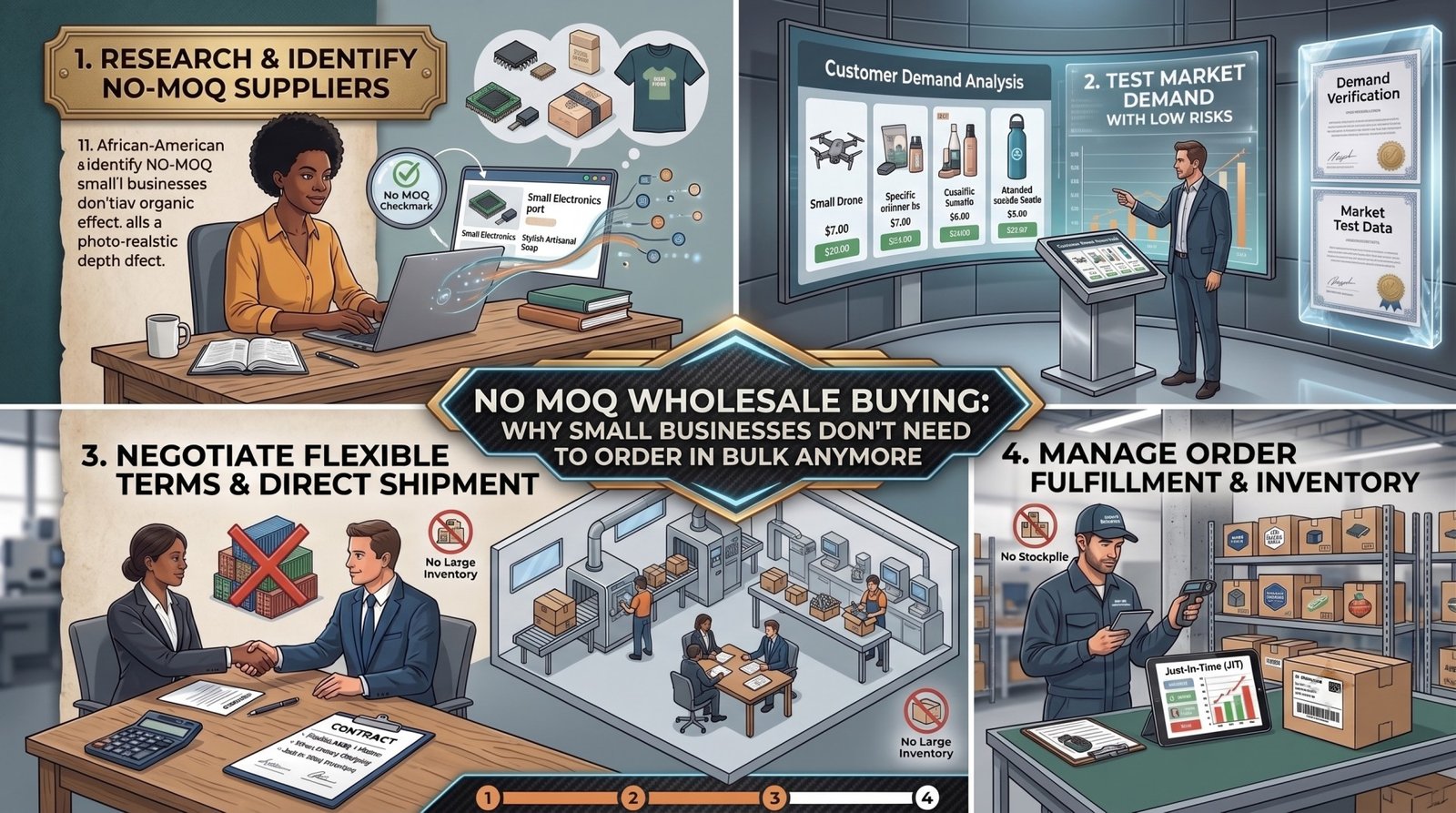
No MOQ Wholesale Buying: Why Small Businesses Don't Need to Order in Bulk Anymore
For a small retailer or startup, buying wholesale has traditionally meant one thing: ordering a large quantity of products upfront. High Minimum Order Quantities (MOQ) can force businesses to invest significant capital before they even know whether a product will sell.
Today, no MOQ wholesale buying is changing how small businesses approach inventory. Instead of committing to hundreds or thousands of units, retailers can explore smaller quantities, test customer demand, and increase their orders once a product proves successful.
This approach can be particularly useful for startups, online sellers, boutique retailers, and businesses that are still experimenting with new product categories.
What Does "No MOQ" Actually Mean?
MOQ stands for Minimum Order Quantity. It is the minimum number of units a supplier requires a buyer to purchase in a single order.
For example, a manufacturer may specify an MOQ of 500 pieces. Even if a retailer only needs 50 pieces to test the market, the supplier may require the buyer to purchase all 500.
No MOQ means the supplier allows buyers to purchase without a fixed minimum quantity, or with a very low minimum order requirement.
However, no MOQ does not necessarily mean that every product can be purchased as a single unit. Suppliers may still have practical requirements based on production costs, packaging, customization, shipping, or product type.
Therefore, buyers should always confirm the supplier's actual minimum quantity before placing an order.
No MOQ vs Traditional Wholesale
Traditional wholesale purchasing often focuses on large-volume orders in exchange for lower unit prices.
No MOQ sourcing takes a different approach: the buyer can start with a smaller quantity, evaluate the product, and increase the order when demand becomes clearer.
This makes inventory purchasing more flexible, especially for businesses that do not yet have predictable sales data.
The Problem With Traditional Bulk Ordering
Large MOQs can create several challenges for small businesses.
Too Much Capital Locked in Inventory
If a business purchases 1,000 units of a new product, a significant amount of money becomes tied up in inventory.
That capital could otherwise be used for marketing, packaging, website development, operations, or testing other products.
Risk of Unsold Stock
A product may look promising during supplier research but perform poorly once it reaches customers.
When the initial order is large, slow-moving products can occupy valuable storage space and reduce available working capital.
Limited Product Testing
Businesses often want to test several products before deciding which ones deserve larger investments.
High MOQs make this difficult because testing multiple products can require a large upfront budget.
Storage and Management Costs
Bulk inventory requires storage, handling, packaging, and inventory management.
For small businesses operating from homes, small offices, or limited warehouses, large quantities can quickly become difficult to manage.
Benefits of No MOQ Sourcing for Startups & SMEs
No MOQ wholesale buying gives smaller businesses more flexibility when building their product range.
Lower Initial Investment
One of the biggest advantages is the ability to start with a smaller purchase.
Instead of committing a large amount of capital to an untested product, a retailer can begin with a smaller quantity and evaluate actual customer demand.
Easier Product Testing
Businesses can test different designs, colors, models, or product categories without purchasing large quantities of each.
This can help identify which products customers are actually interested in.
Better Cash Flow Management
Cash flow is particularly important for startups and small businesses.
Smaller inventory commitments can leave more working capital available for daily operations, marketing, salaries, logistics, and other business expenses.
Reduced Inventory Risk
If a product does not perform as expected, having a smaller initial stock reduces the potential impact of unsold inventory.
More Product Variety
A retailer with a limited budget may be able to stock multiple product categories instead of investing most of its budget into one bulk order.
This can help businesses create a broader catalogue while they learn what sells.
How to Test Products Before Scaling Up Orders
No MOQ sourcing works best when businesses treat the first purchase as a product validation stage rather than immediately trying to maximize inventory.
1. Select Products Based on Demand
Research your target customers and identify products that solve a clear need or have existing market demand.
Consider factors such as:
-
Search demand
-
Competitor pricing
-
Customer reviews
-
Product trends
-
Seasonal demand
-
Target customer preferences
-
Existing sales data
2. Start With a Small Quantity
Instead of ordering large quantities immediately, begin with a smaller batch where the supplier allows it.
The purpose is to understand how the market responds before making a larger investment.
3. Check Product Quality
Evaluate the actual product rather than relying only on supplier photographs or descriptions.
Check:
-
Material
-
Size
-
Finish
-
Packaging
-
Functionality
-
Durability
-
Product consistency
If the product is being sold under your brand, also check whether the supplier can maintain consistent quality across future batches.
4. Test Your Sales Channels
Use your available sales channels to measure customer response.
Depending on the business, this could include:
-
E-commerce websites
-
Marketplaces
-
Social media
-
Offline retail stores
-
B2B sales
-
Distributor networks
-
Paid advertising
Track which products generate inquiries, sales, repeat purchases, and positive customer feedback.
5. Scale the Products That Perform
Once a product demonstrates consistent demand, increase the order quantity.
Larger orders may allow you to negotiate better pricing with the supplier and improve your overall margins.
This creates a simple cycle:
Small Test Order → Customer Feedback → Sales Data → Supplier Negotiation → Larger Order
Instead of guessing how much inventory customers will buy, businesses can use actual market data to make purchasing decisions.
Is No MOQ Right for Your Business?
No MOQ sourcing can be useful, but it is not automatically suitable for every business or every product.
Before choosing a supplier, consider the following factors.
Your Product Category
Some products are easier to source in small quantities than others.
Standard products that are already manufactured may be available with flexible quantities, while highly customized products may require a higher MOQ because the manufacturer has additional setup and production costs.
Your Target Margin
Small orders can sometimes have a higher per-unit cost than bulk purchases.
Therefore, compare the complete cost of sourcing, shipping, packaging, taxes, and other expenses against your expected selling price.
Your Sales Volume
If you already have strong and predictable demand, bulk purchasing may make commercial sense because larger quantities can sometimes provide better unit economics.
For a new product with uncertain demand, smaller initial orders can provide more flexibility.
Supplier Reliability
A low MOQ is useful only if the supplier can consistently deliver the required product quality and quantity.
Check the supplier's business information, product samples, communication, lead times, and commercial terms before developing a long-term relationship.
No MOQ Does Not Mean No Planning
Even with flexible ordering, businesses should maintain proper inventory planning.
Monitor:
-
Stock levels
-
Sales velocity
-
Reorder points
-
Lead times
-
Product margins
-
Customer returns
-
Supplier performance
The goal is not simply to buy less. The goal is to buy according to actual demand.
Final Thoughts
No MOQ wholesale buying is giving startups and small businesses a more flexible way to approach inventory procurement.
Instead of investing heavily in products before knowing whether they will sell, businesses can start with smaller quantities, test products, gather customer feedback, and scale successful products over time.
For new retailers and growing e-commerce businesses, this approach can help reduce inventory risk and make better use of limited working capital.
However, buyers should still evaluate product quality, supplier reliability, landed costs, delivery timelines, and future pricing before committing to a supplier.
The right sourcing strategy is not necessarily about placing the biggest order. It is about finding the right balance between price, quantity, quality, demand, and cash flow.